
Let’s talk leash-walking gear. What collar or harness will stop my dog from pulling on leash?
As much as it is so compelling to think that if we could just find the perfect gear, our dog would come to the sudden realization that pulling makes walks un-fun for us, that's not the reality we live in. Putting the Never Pull Again 5000 harness or collar on your dog isn't going to solve what is essentially a problem of training or motivation. You might find that some gear takes the sting out of the pull for you (often at the cost of your dog's joints), or that some gear makes your dog afraid of the consequences should they pull... but ultimately, neither tells your dog "Hey bud, I would like you to walk with me with slack in the leash so that we can both enjoy this walk.”
The real truth of it is that your gear doesn't train your dog, you do.
You'll often hear people repeat the worn out adage "Harnesses teach dogs to pull!" The harness is an inanimate object. It's not teaching your dog a thing. Your reaction, on the other hand, absolutely teaches your dog something.
What a harness does is this - it keeps your dog safe if pressure does get in the leash.
In a 1992 study by Anders Hallgren on 424 dogs believed to be healthy, it was found that of the dogs who had been known to pull hard on their leash on a neck collar, or who had experienced leash jerks from a handler, 91% were found to have damage to their necks when examined for the study.
Here’s Anders Hallgren’s website page about the study that was released as an ebook.
Here’s a pdf that shares the text of the study in question.
What if my dog does pull in a harness?
If a particular dog does pull more on a harness, it's likely due to 2 reasons:
The dog hasn't been explicitly trained not to pull on the leash.
The harness causes less pain/injury or discomfort than other gear.
These aren't reasons to avoid a harness, but they are reasons to train your dog to walk appropriately on leash, regardless of gear used.
So what gear do I suggest?
With few exceptions, my suggestion is to stick with a harness - contrary to popular opinion, teaching appropriate behavior on leash does not require harsh techniques or equipment.
That being said, it's important to keep in mind that your gear does not train your dog - you do. A "no pull" harness doesn't teach your dog not to pull, it only reduces the impact of the pulling on you.
To select the best harness for your dog, you'll want to look for one that is ideally H-style with a Y-shaped front, and has a clip or ring available on the front and the back.
H-style harnesses allow your dog's shoulders to have freedom of movement. Some popular no-pull or front-clip harnesses go over your dog's shoulder and directly impede their movement and can risk long-term effects to their joints. The harness my younger dog was sent home in was this style.
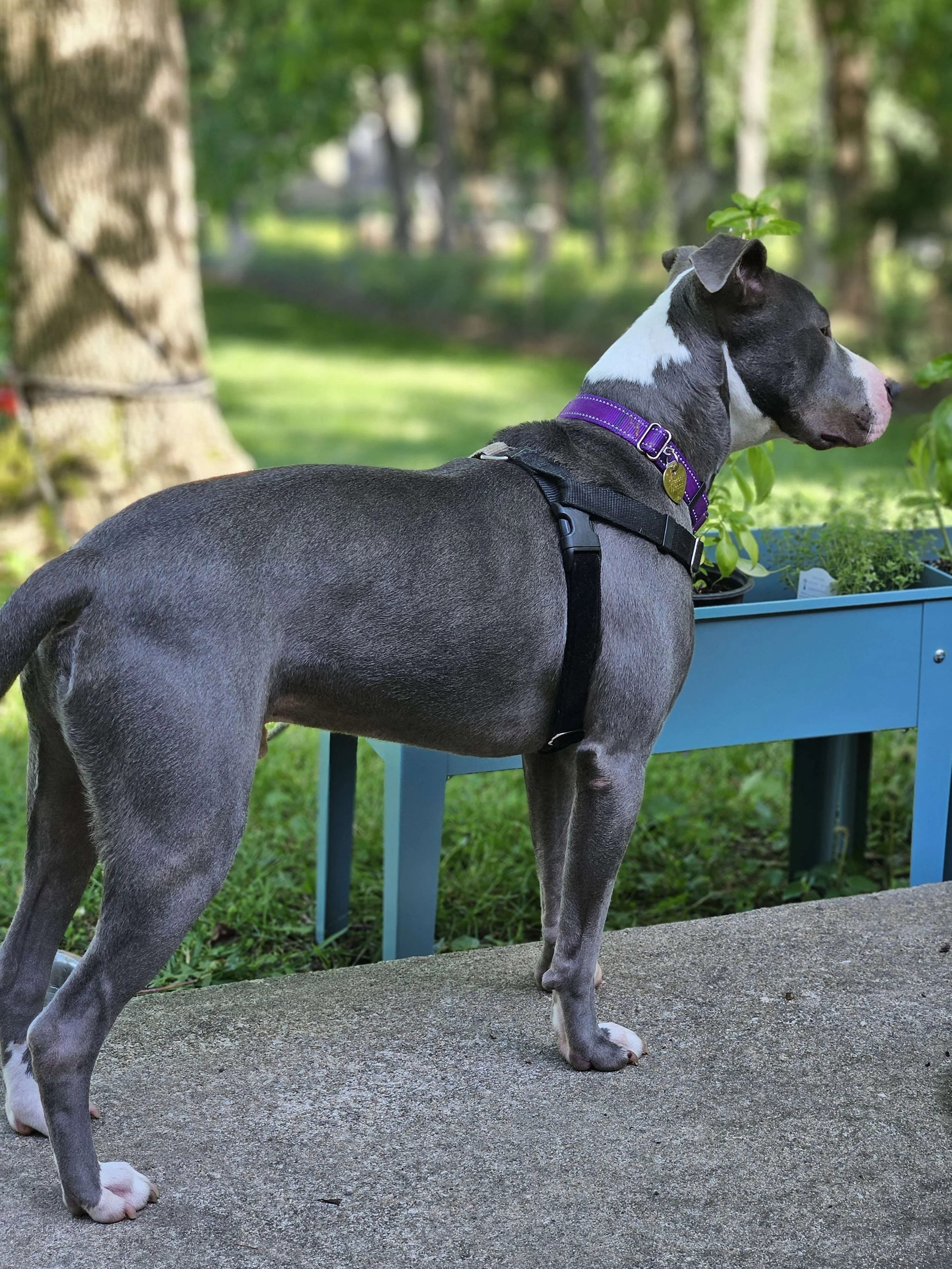
No-pull harness
Gideon came home in a harness this style, but it isn’t the type of harness I recommend or regularly use.
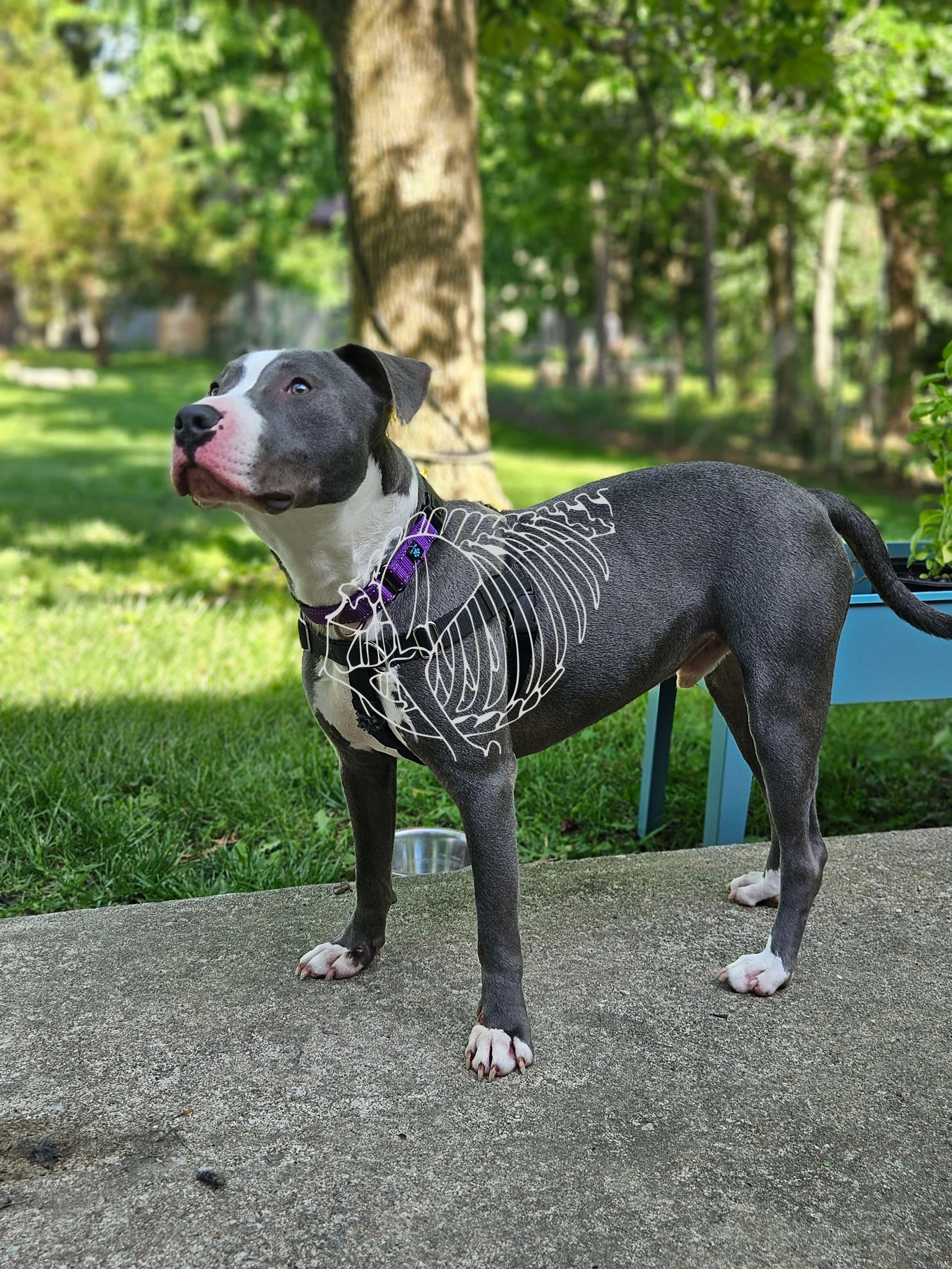
No-pull harness
This has a drawing of a canine skeleton overlaid on the image to give you a rough visual of the kind of joints impacted by the location of the straps on this harness.
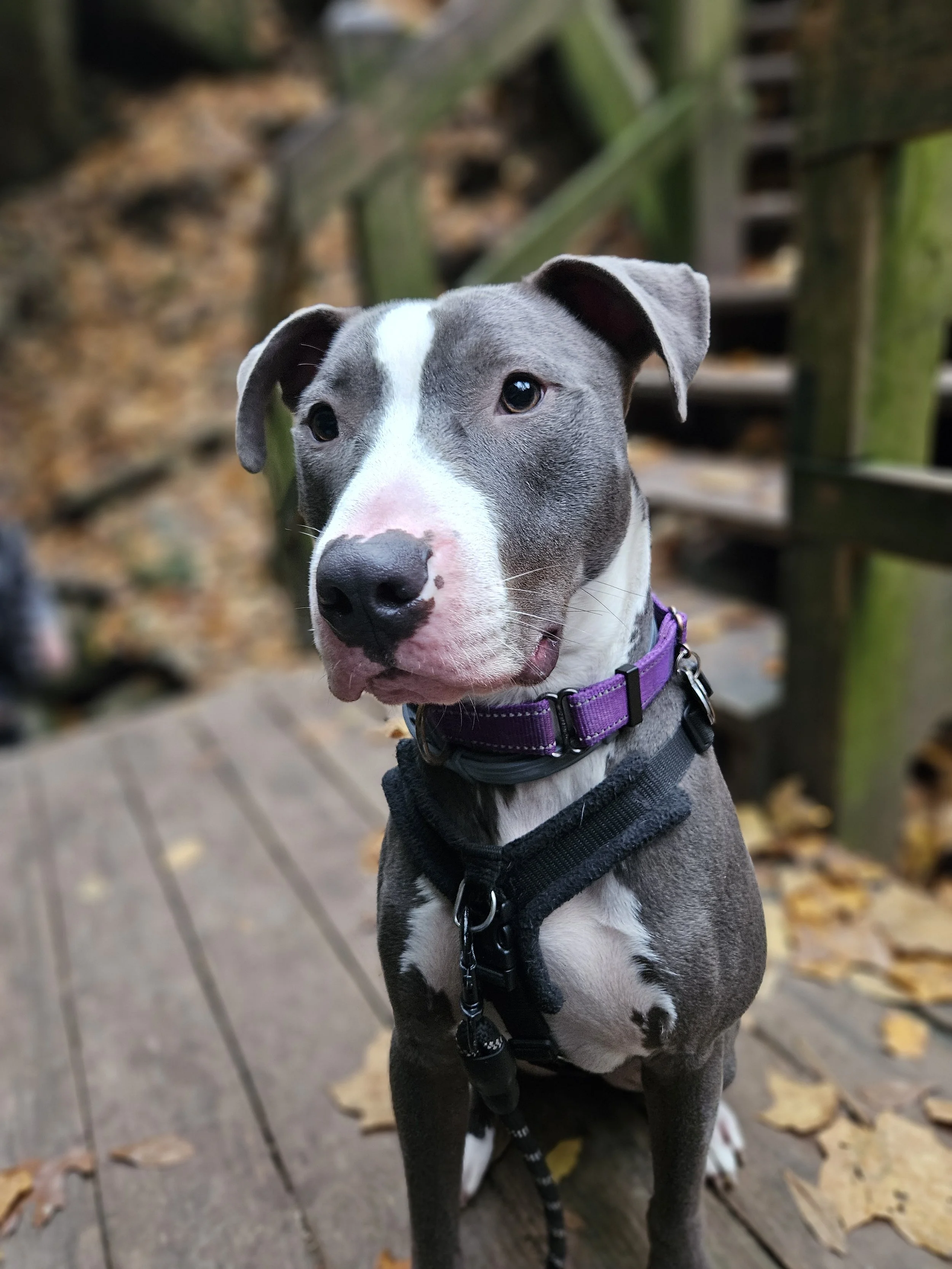
Y-Front
Y-front harnesses can be a singular piece like this one that is Y-shaped, or can be 3 different nylon straps connected with an o-ring. As long as it’s roughly Y-shaped and fits on your dog lower than most of the neck/more on the chest, that’s what you’re looking for!
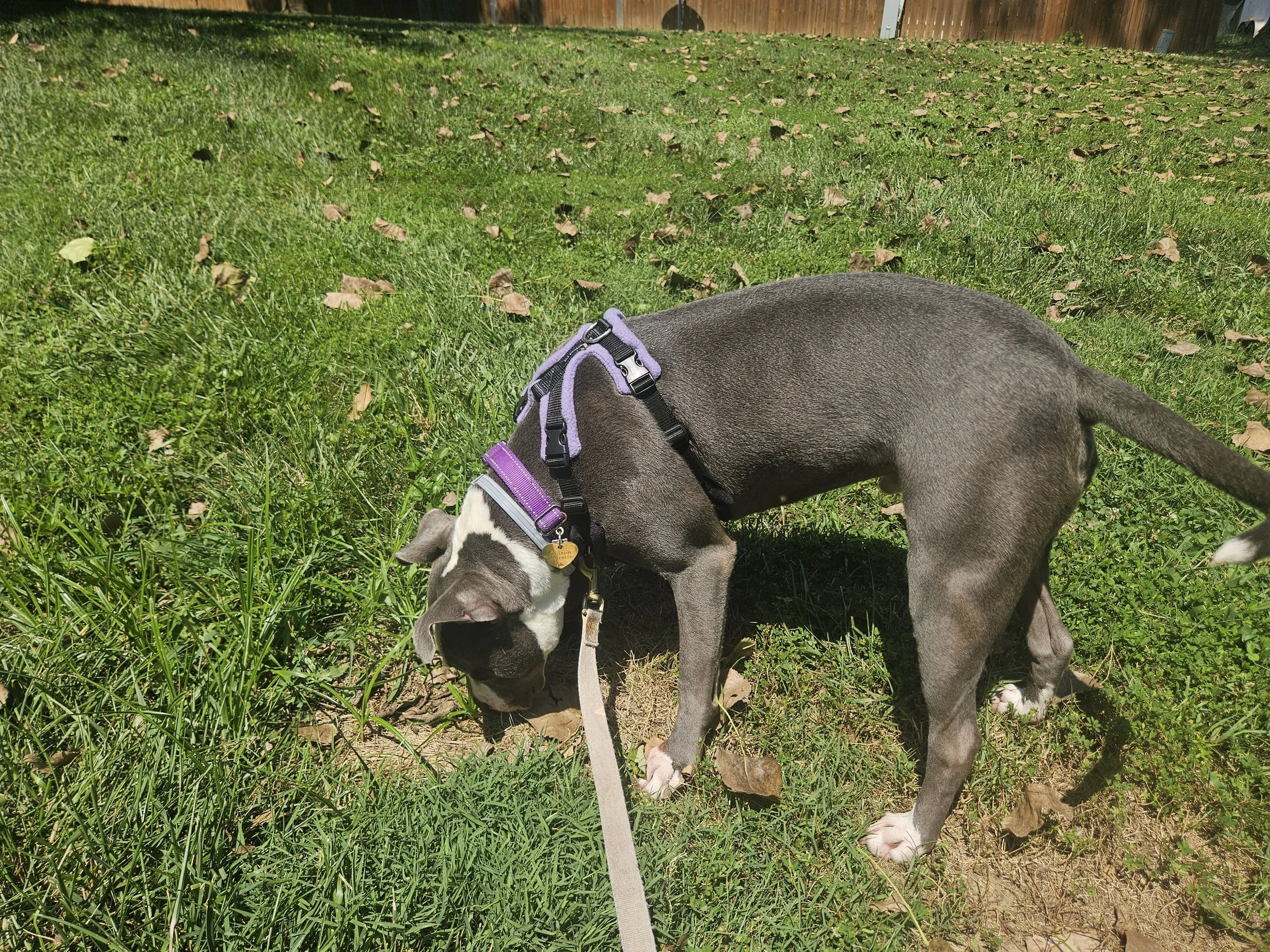
H-style harness
When viewed from above, this harness looks like an H. The shoulders/elbows have more freedom of movement than the no-pull harness allows.
You can see from the photos where it would restrict his shoulders, and why I wouldn't recommend the use of these long-term. Once we found an H-style harness that fit his proportions correctly, we switched him out of this harness.
A Y-front harness helps ensure that the front strap isn’t putting pressure on the fragile parts of a dog's neck - you don't want your harness to have the exact problems you're trying to avoid in neck collars!
I prefer a harness that is made of straps or webbing over one that is made of a wide fabric or mesh, as I find they're often much more adjustable and stretch out or gap less.
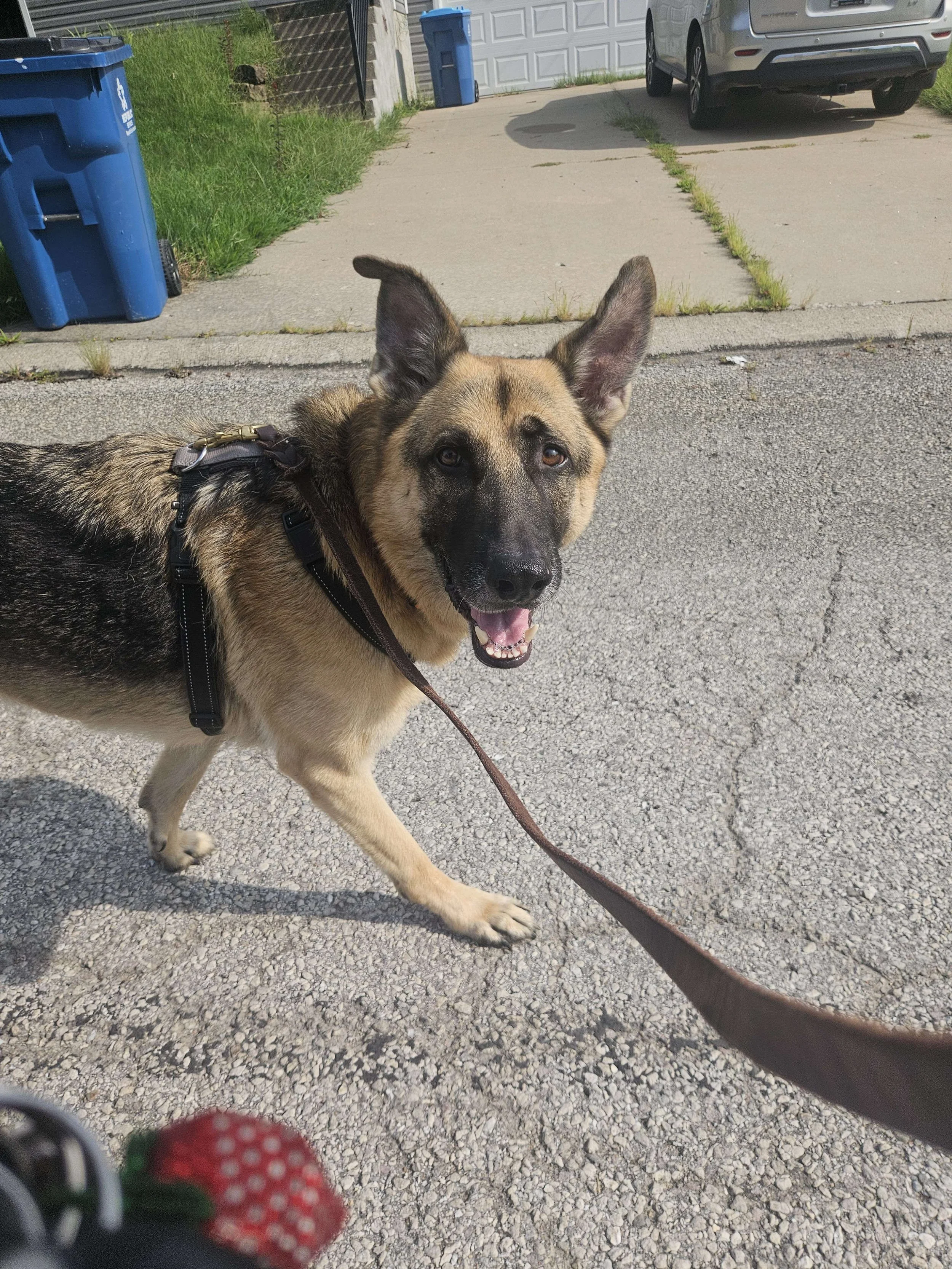
PetSafe 3-in-1 Harness
A client dog, Dallas, demonstrates the PetSafe 3-in-1 harness - my older dog Juniper uses the same brand of harness.
There are a lot of brands out there. My older dog currently uses a PetSafe 3-in-1. Overall, I like it, but the nylon strap between the legs is a bit thin for the buckle they chose, so it loosens constantly. It is fine for Juniper, but I wouldn't recommend it for a Houdini dog unless it fit perfectly on the loosest setting.
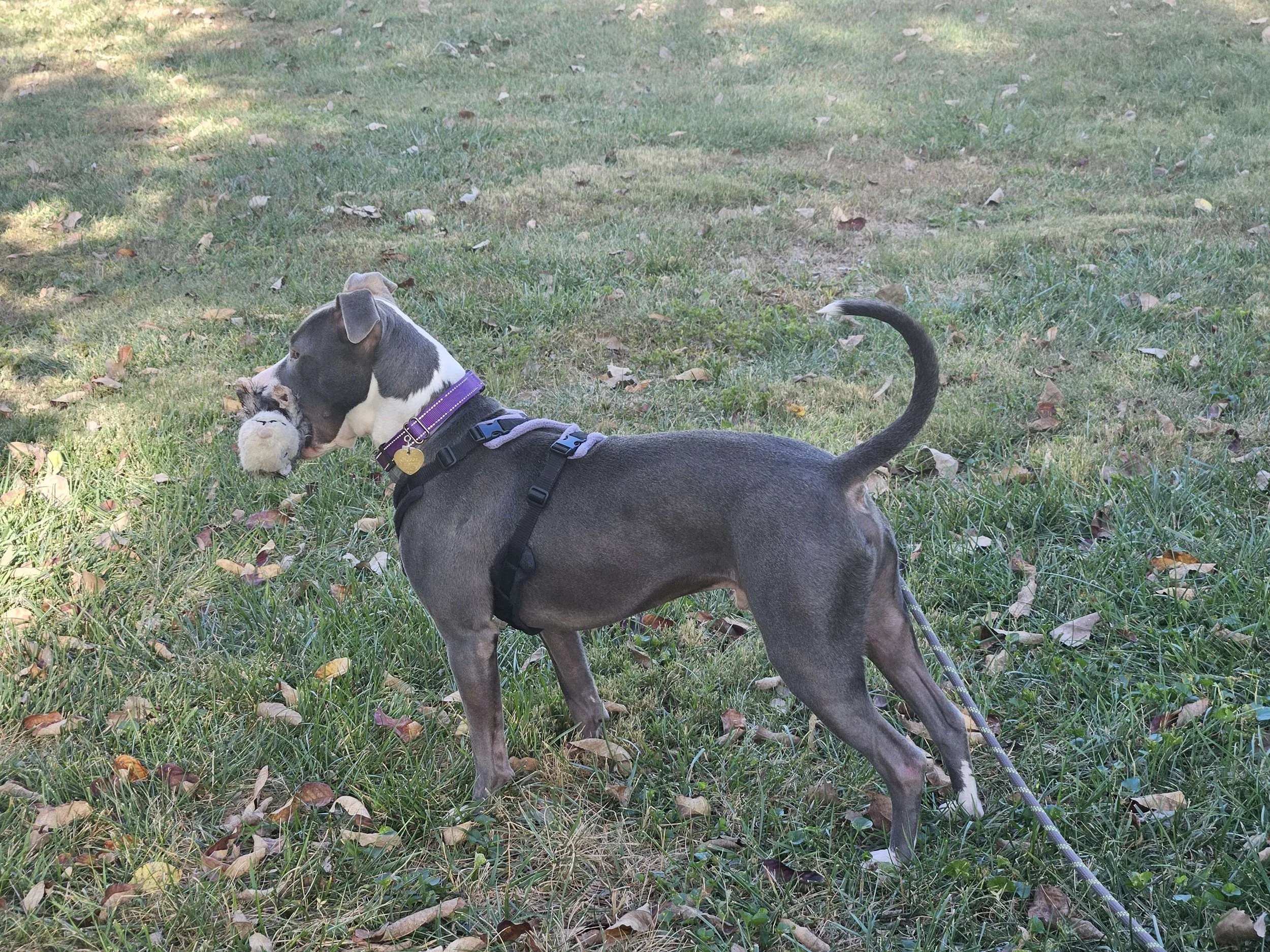
Perfect Fit Harness
Gideon demonstrating his Perfect Fit harness (while carrying his possum toy outside).
My younger dog walks in a Perfect Fit harness. I adore this harness, as it comes in 3 pieces, and you can select the size for each piece to get the correct fit for your dog. My only gripe is similar to the PetSafe - I would have used a thicker nylon webbing (in thickness, not width) were I designing it myself, as some of the straps are prone to slowly loosening. With that, keep in mind that my dog’s harness is the narrower of the two webbing size options, so the other size might not have the same concern.
I've also seen the Balance harness (sturdy nylon, H-style but not Y-front) and the Haqihana harnesses (sold through Clean Run in the US) recommended. The Haqihana does not un-clip at the neck, so it is put on over your dog's head - keep that in mind when picking a harness if you have a dog who finds that uncomfortable!
Okay, and what about the leash?
To make training easier on yourself, I recommend a simple 6-foot flat leash with a loop at the end for a handle. There's a multitude of brands. Some have a D-ring by the handle which can be convenient for attaching your poop bag holder. Some have a traffic handle built in at the clip-end of the leash. It's up to you if these bells and whistles are convenient or in your way.
The things I want you to avoid are simple:
No bungee leashes
No retractable leashes
These both have safety concerns and allow your dog to keep moving forward with tension in the leash.
One of the most crucial parts of loose leash training is this:
Don't reward the pulling. If there is tension in the leash you don't walk forward. Ever. Be consistent. Don't be a slot machine where pulling works "sometimes" - that makes it worth trying.
Continuing to walk when there is tension in the leash rewards pulling, and behavior that is rewarded will be repeated.
A bungee or retractable leash for a normal walk will make your training process slower and more difficult at best.
For some training exercises to help you and your dog start walking together, check out my other blog post on loose leash walking - in that post I get into the weeds with 5 exercises I consider foundational to having really lovely walks.