
It seems like everywhere I look lately, I see posts from dog guardians who are at the end of their rope.
They're getting dragged around on walks. They've tried 15 different no-pull harnesses, collars, tools, gadgets, devices. Either they make no difference, or the dog doesn't seem to learn anything long-term – the dog can only stop pulling while the new tool is on them, but the second it's off, they're sled dogs again.
And I get it! It can be overwhelming and frustrating to try to walk a dog who can’t seem to understand that you would like your arm to stay attached to you, thank you very much. It can even feel embarrassing, as if you’re the only one at the park whose dog can’t get it together (you’re not alone, I promise!).
They post in all the dog behavior support groups online, asking what else they should try, which tool or gear actually stops pulling?
The secret is, none of them do. Not really.
Now, don't lose hope - you can stop getting dragged on walks. You just don't need to find the perfect tool to do it. The gear is there as a safety net, but it doesn't train your dog. You do.
I get more in depth on what gear I do recommend in another post (You can check it out at this link), but the short answer is: whatever gear is the safest and most comfortable, because it doesn't train your dog - you do.
To get peaceful walks, you need to do 3 things:
1) Don't reward the pulling. If there is tension in the leash you don't walk forward. Ever. Be consistent. Don't be a slot machine where pulling works “sometimes” - that makes it worth trying.
Continuing to walk when there is tension in the leash rewards pulling, and behavior that is rewarded will be repeated.
2) Reward what you do like. All of it. With whatever rewards your dog likes and will work for. Food, praise, pets, play, and even “go sniff that bush” are rewards.
Keep high value treats on you every walk but don’t limit your rewards to food, get creative. Sometimes sniffing is the most effective reward.
3) Teach the SPECIFIC behavior you want, intentionally.
The question I ask myself: What behaviors do I want on leash?
If there's tension in the leash, I want my dog to put slack in the leash. I use the leash pressure game to teach it.
If I'm walking, I want my dog to hang out in a 2-4 foot radius of my left leg. (I hold my leash in right hand, dog on left side, treat pouch easy to reach w left hand.)
I want my dog to go sniff and be a dog when appropriate, and to come with me away from distractions when asked.
I like to start “loose leash walking” (LLW) training with a few foundation games.
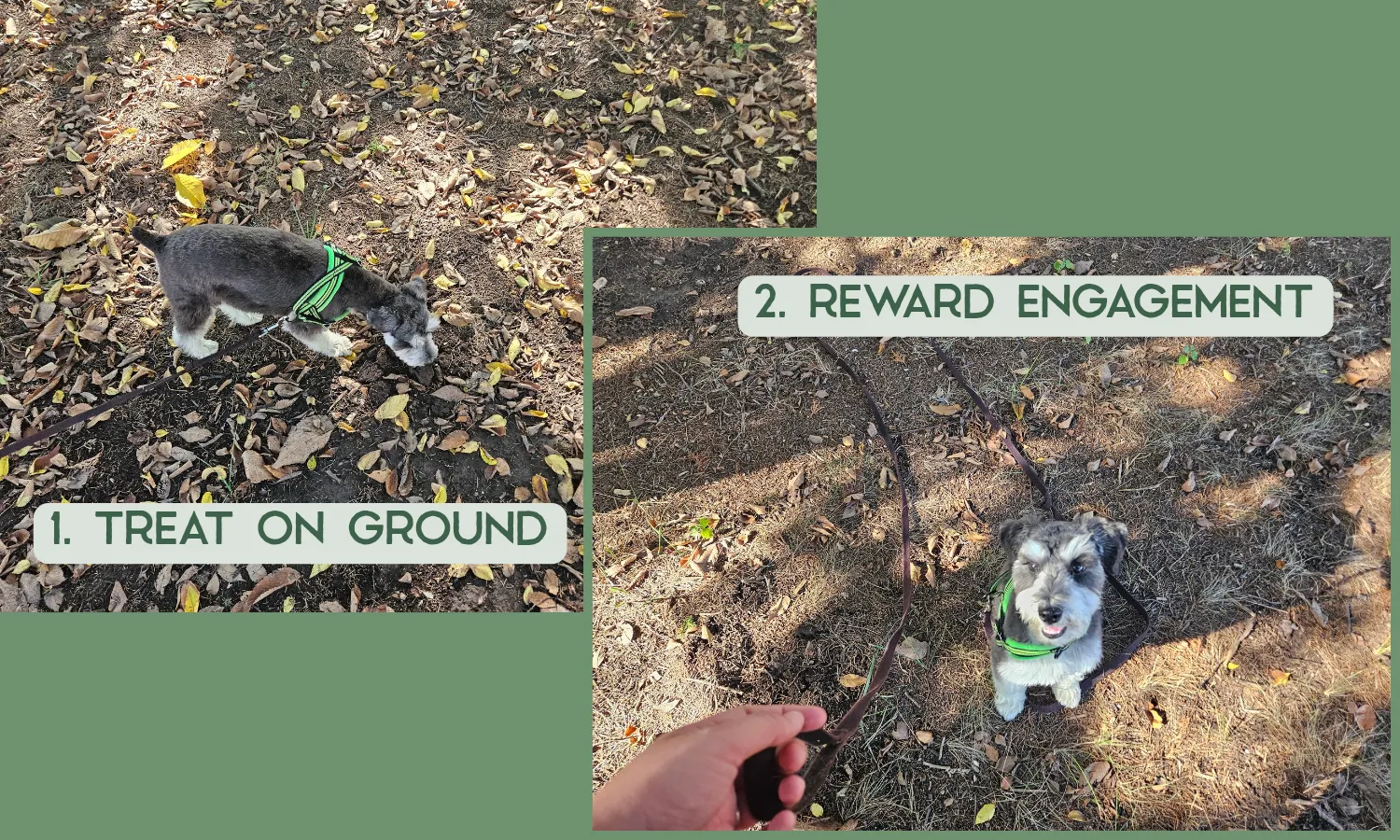
Miniature Schnauzer Murphy practices the engagement game on a long line during one of his day training lessons.
ENGAGEMENT GAME aka UP/DOWN GAME
Start by rewarding attention. Dog looks at you, “yes!” + treat dropped on ground.
Take a step or two away. Wait for attention.
When your dog looks at you, “yes!” + treat on the ground.
Repeat until your dog is eagerly engaged with you and focused.
If this is too hard you might be starting in too high distraction an environment or the dog may need to work on just attention first. If this isnt too hard, move on to the other games!
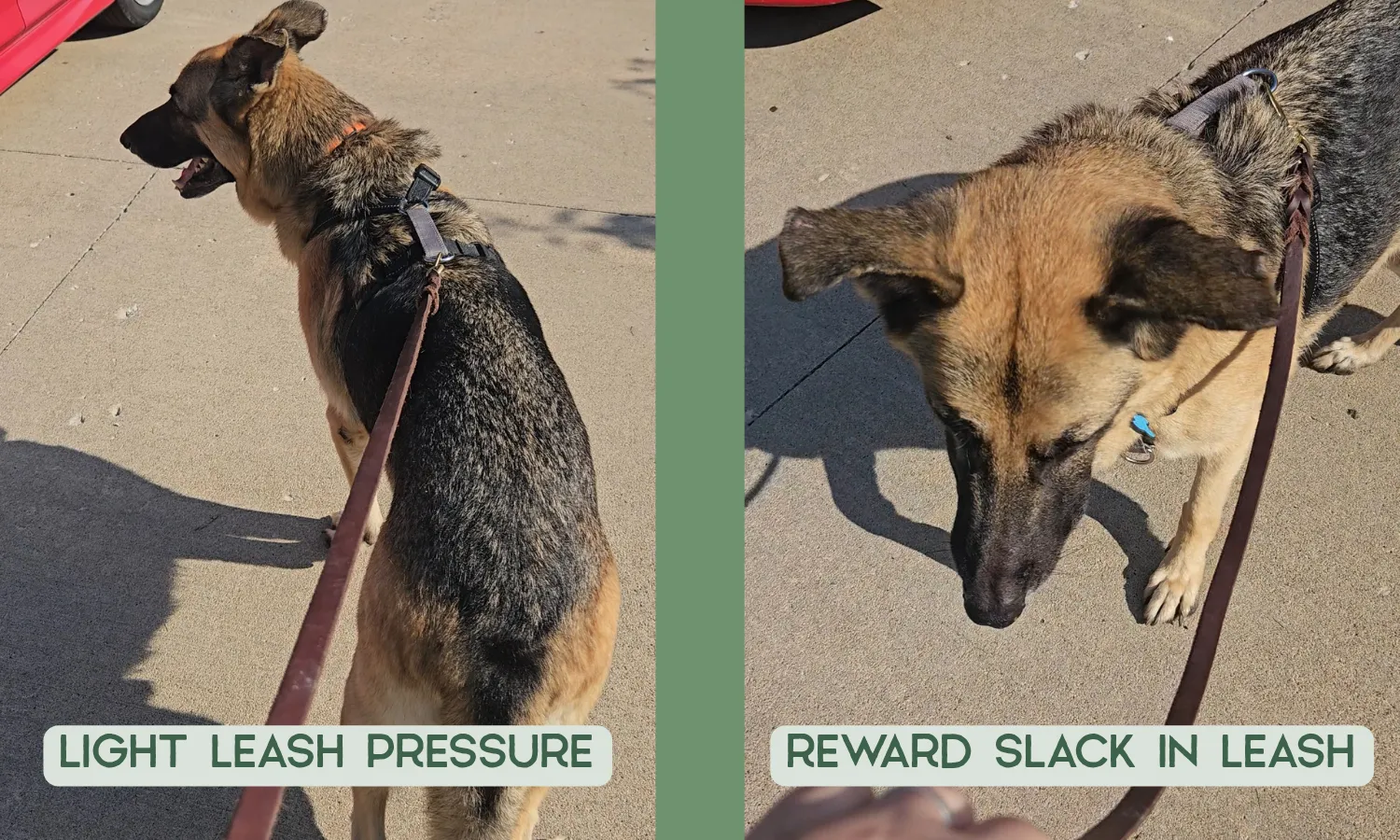
German Shepherd Dallas practices the leash pressure game in his driveway before starting his walk.
LEASH PRESSURE GAME
The leash pressure game is taught on a harness.
I put a very small amount of pressure in the leash (just enough they can feel it).
Wait.
The second they put slack in the leash, mark and reward (you can use a clicker or just say “yes!” or “good” to mark the second they get it right. Reward comes after the marker.)
Practice indoors low distractions and baby step your way up.
I'll also add distractions I control to this game, like a treat tossed on the ground just out of reach. Wait for slack, “yes!” or click, treat, “okay, get it!”
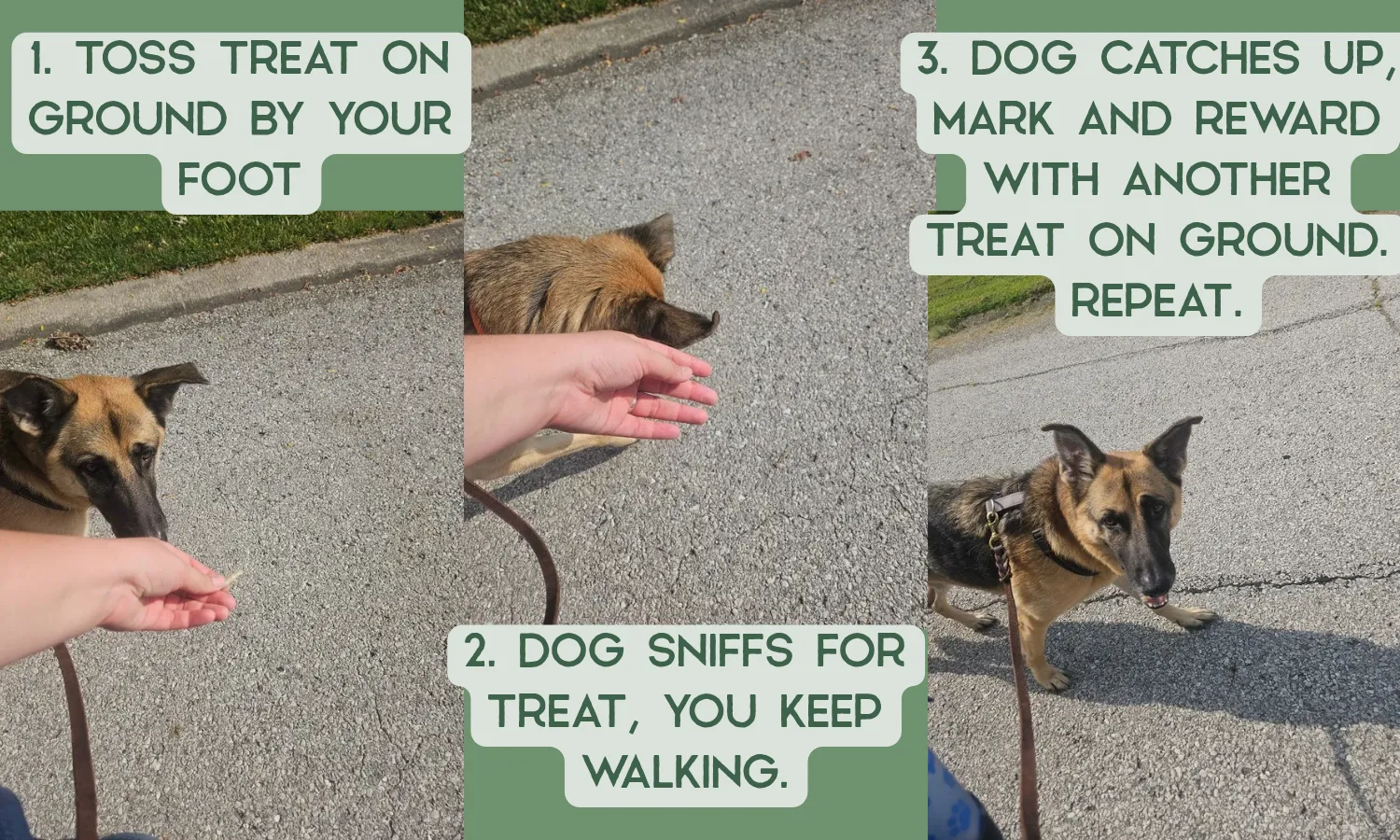
German Shepherd Dallas demonstrates the “Catch-Up” game on his day training walk - he caught on to this game quickly and loves to check in when he catches up instead of bolting ahead now!
PLAY CATCH-UP
The idea behind this exercise is “you can't pull ahead of me if you're always catching up.”
For this game leash in your right hand dog on your left side. Hold the leash so there is slack in it, and dog has plenty of room to move. Don't try to hold the dog in place with the leash.
If that's hard, try to focus on giving your dog at least 4-6ft of leash and target your thumb to your belly button to keep yourself from putting unnecessary tension in the leash. It's easy for us to do when we're stressed!
To play the game:
Treat on ground by your left foot (about where your pant seam is).
Take a step or two WHILE dog is eating.
When dog has ALMOST caught up, mark and reward with another treat, again on the ground.
Repeat.
So you end up with a loop.!
Treat on ground, walk, dog catches up, yes!, treat on the ground, walk, etc.
Eventually the dog stops trying to dart ahead right away and will take 1 or more steps beside you. You can start varying when you reward then. Right away sometimes, after 3 steps sometimes, after 1 step sometimes, and so on.
Over time, your dog will stay with you longer and longer without darting ahead, and you can start rewarding directly to the dog for staying with you occasionally instead of always needing to play the game.
Often, when I'm teaching dogs to walk in in a 2-4ft bubble by my side using the Catch Up game, I'll also put that on a cue like “with me” so that I can tell them when I want them with me, versus when theyre free to wander and sniff.
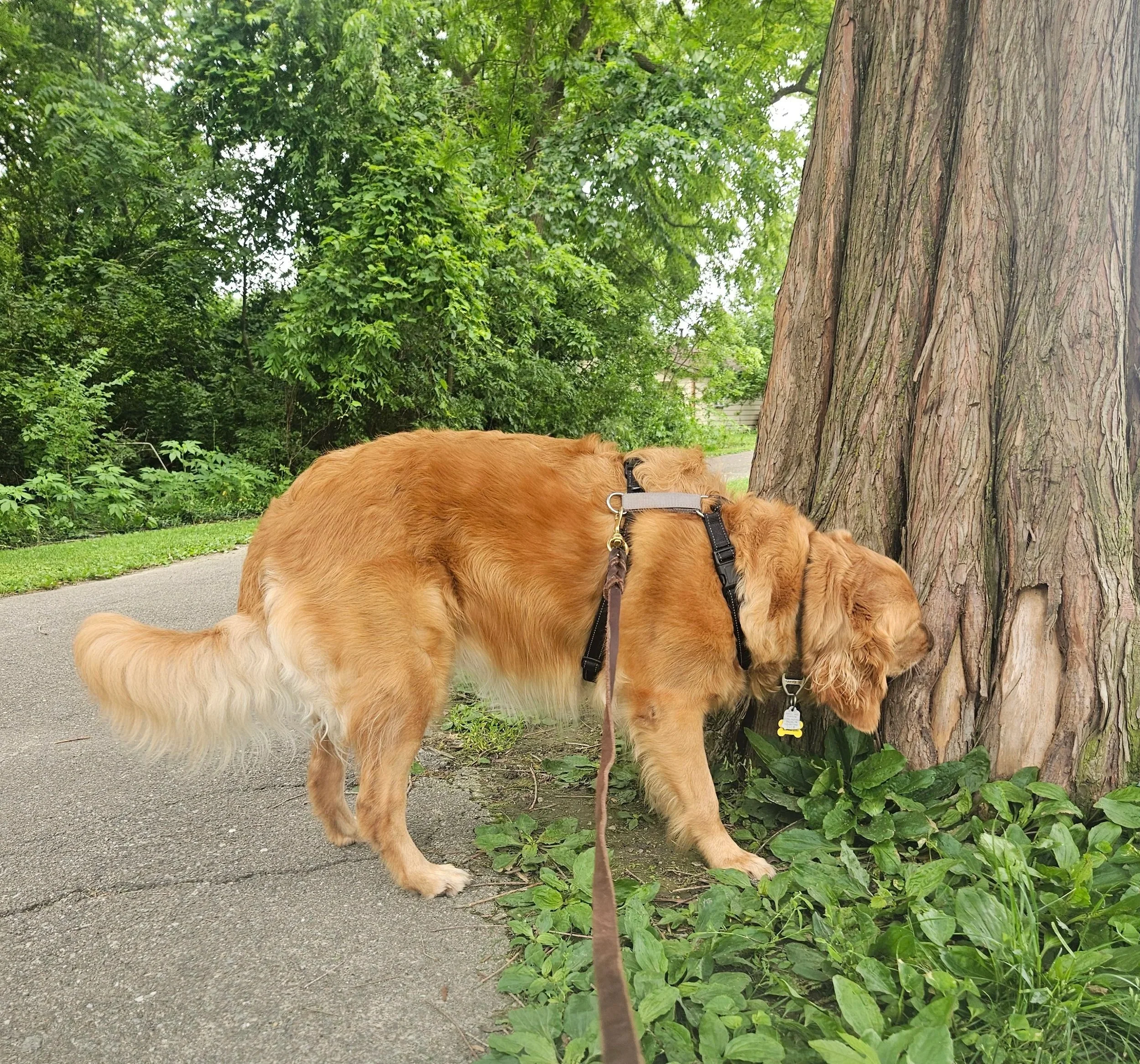
“Go sniff!”
Golden Retriever Dela finds “real life” rewards more exciting than most treats outside. A lot of her leash walking training involved using sniffing as a reward for walking on a loose leash.
GO SNIFF and LET'S GO
Now with all that in mind, as much as I don't want my dog to pull my arm off dragging me down the street or trail, the most important thing to remember is this:
The walk is for the dog.
I want my dog to be capable of walking by my side. I want them to keep slack in the leash. I want them to be able to handle distractions. I ALSO want them to be a dog and sniff and enjoy their walks.
So I teach them 2 cues - “go sniff” and “let’s go.”
You can teach “go sniff” by naming the behavior when they're already doing it on their own, if you do that consistently. They learn “oh, this is go sniff!” by association, and your dog can then learn to do it when you say it -- sniffing is rewarding on its own!
You can also teach go sniff with a treat scatter + saying the cue, to give the dog a bit of a jump start. If there are treats to find, a dog will sniff to find them!
I like to teach “Let’s go” with low distractions first. On leash when walking, I turn around and say “let's go!” in a cheerful tone, and make it seem fun to go with me, then reward when the dog catches up. You can give the reward to the dog directly, but you can also reward by tossing the treat ahead of you to build some speed and enthusiasm in following when you say “let's go” - not all dogs need that, but some do!
These exercises aren't the only ways you can teach your dog what TO do by far - but they are some simple and helpful exercises that work for a lot of dogs.
That being said, I get that it can feel overwhelming! You're trying to make your own training plan, decide what game to practice first, figure out where to practice, decide how to get your dog to do this with distractions instead of in your living room, and so on.
You can absolutely try to DIY this. You also absolutely do not have to. Check out our private lesson and day training programs if you want some 1-on-1 support creating walks you and your dog can both enjoy.